

Key Takeaways
What they are: cable machines use a weight stack and cabled pulleys to deliver smooth, constant resistance through a full range of motion.
The main types: functional trainers, cable crossovers, single towers, multi-station gyms, all-in-one racks, and the new smart digital systems.
Why they are popular: versatility, joint-friendly resistance, safety without a spotter, and hundreds of exercises from one compact machine.
The 2026 shift: smart cable machines replace the weight stack with digital resistance and add AI coaching and guided workouts in a tiny footprint.
How to choose: match the type to your space and goals, then weigh cable ratio, stack size, build quality, attachments, and whether you want smart features.
Best all-rounder: for most home and studio gyms, a functional trainer remains the most versatile cable machine you can buy.
Few pieces of equipment do as much as a cable machine. The lat pulldown appears on nearly every back day, and functional trainers now stand at the center of home gyms, and across the category cables deliver smooth, constant resistance and hundreds of exercises from a single station. They build muscle and protect joints, and they let you train the whole body without a spotter, which is why they appear in every commercial gym and an ever-growing share of home setups.
In 2026, the category is broader and more interesting than ever. Alongside the classic stack-and-pulley machines, a new generation of smart, digital cable systems uses motors and magnets to create resistance and adds AI coaching, all folded into a closet-sized footprint. This guide covers all of it: how cable machines work, every type available today, their benefits and best exercises, the rise of smart machines, and how to choose the right one for your space and goals, within your budget.
What Is a Cable Machine?
A cable machine is any strength-training machine that provides resistance through a cable running over pulleys, connected to a weight source. You pull or push against the cable using a handle, bar, rope, or strap, and the machine resists that movement. The signature quality of a cable is constant tension: unlike a free weight, which only loads the muscle when gravity opposes the movement, a cable keeps resistance on the muscle through the entire range of motion, both as you lift and as you lower.
That single feature, combined with the ability to pull from almost any angle, is what makes cables so versatile. A cable machine can press, row, pull down, curl, extend, squat, and rotate, covering nearly every muscle group and movement pattern. It is also the only practical way to perform some of the most popular exercises in the gym, the lat pulldown and the cable row chief among them, which is why a cable machine is a non-negotiable for most serious training spaces.
The Evolution of Cable Machines
Cable machines have come a long way, and knowing that history helps make sense of the range of options today. The earliest cable stations were wide crossovers, roughly 11 feet across, with a single high pulley and a single low pulley at each end. Trainers soon added a cable column that could slide up and down, letting you set the height the resistance came from, though the columns still sat 7 to 11 feet apart, which demanded a lot of floor space.
The breakthrough was bringing those two columns close together into a single compact frame, which created the first true functional trainers, sometimes called simple functional trainers, with a pair of cable columns just 3 to 4 feet apart that moved the pulleys vertically. The next leap added a second independent weight stack. That change gave each arm or leg its own resistance, so a stronger side could not compensate for a weaker one and two people could train at once. Later refinements added pulleys that swivel horizontally as well as vertically, opening up the multi-planar movement that defines a modern functional trainer.
The current chapter, unfolding through the 2020s and into 2026, is the smart machine: the weight stack itself is replaced by motors and magnets, and software takes over the job of setting and shaping resistance. Each generation has chased the same two goals, more exercise variety and a smaller footprint, and the result is a category with a machine for nearly every space and budget.
How Cable Machines Work
Every cable machine, from a basic tower to a high-end smart system, is built on the same simple idea, but a few design choices shape how it feels and what it can do. Understanding them helps you both train smarter and buy the right machine.
Weight stacks and resistance
Most traditional cable machines use a selectorized weight stack: a column of steel plates you select with a pin. Pull the cable, and you lift the plates you have pinned. Many machines have two independent stacks, one per cable, which lets you train each arm on its own and lets two people work at once. Some machines are plate-loaded instead, taking the same weight plates you would put on a barbell, which lowers the cost and raises the ceiling on maximum load. The newest smart machines skip plates entirely, generating resistance with electric motors or magnets, a shift we cover in detail below.
Pulleys and cables
The pulley routes the cable and, on adjustable machines, sets the height and angle you pull from. The number and flexibility of pulley positions is one of the biggest differences between machine types: a functional trainer might offer 19 or more height settings per side with pulleys that swivel to any angle, while a cable crossover typically offers only a few fixed positions. The cables themselves are usually coated aircraft-grade steel rated to a high tensile strength, since they take heavy repeated loads and are the part most likely to eventually need replacing.
Cable ratio
Cable ratio is the specification most buyers overlook, and it changes how the weight feels. It describes how the stack weight translates to the resistance at your hand. A 1:1 ratio gives you the full stack weight, so 100 pounds feels like 100 pounds, which suits heavy strength work. A 2:1 ratio gives you about half, so you feel roughly 50 pounds from a 100-pound stack, in exchange for finer weight increments and double the cable travel for a longer range of motion. Neither is better in the abstract, and some machines now switch between the two.
Attachments
Attachments are what turn one machine into dozens of exercises. Clipping a different handle onto the cable changes the movement entirely, so a small starter set expands the machine considerably. The table maps the common attachments to what they do best.
Attachment | Best for |
Single handles | Presses, rows, curls, crossovers, and unilateral work |
Rope | Triceps pushdowns, face pulls, pullovers, and core work |
Straight or lat bar | Lat pulldowns, pushdowns, rows, and curls |
Ankle straps | Glute kickbacks, hip abduction, and leg work |
Seated row handle | Close-grip rows and back thickness work |
The Types of Cable Machines
Cable machine is an umbrella term, and the differences between the types are what determine which one belongs in your gym. Here are the main categories you will encounter in 2026, from the compact and versatile to the wide and specialized, ending with the new smart systems.
Functional trainer
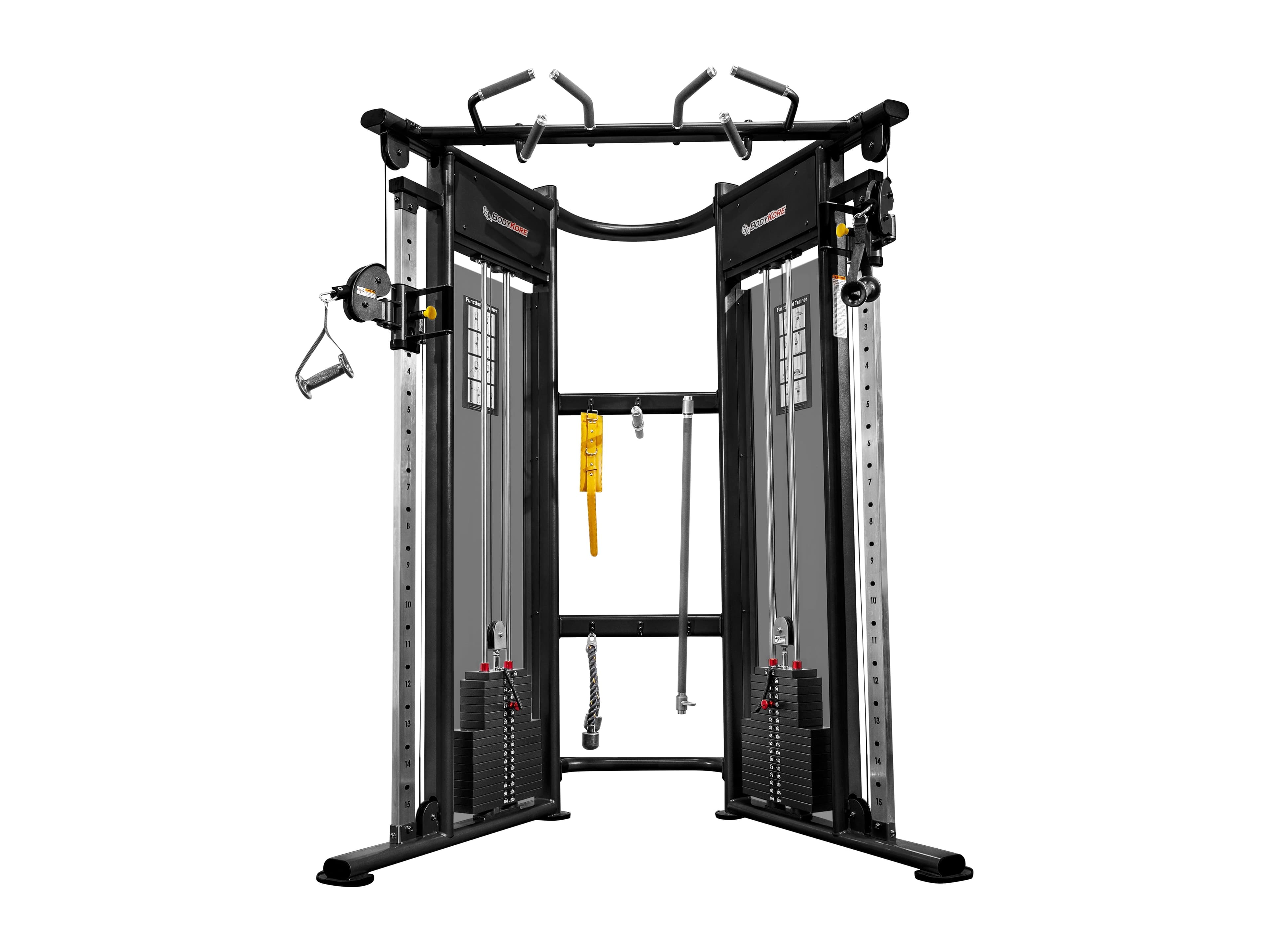
A functional trainer is a compact machine with two independent, fully adjustable pulleys on a narrow frame. Its defining feature is adjustability: each pulley offers many height positions and usually swivels, so you can set the cable to almost any angle and train through every plane of motion. That flexibility makes it capable of hundreds of exercises across the whole body, which is why it is widely considered the best all-round cable machine and the mainstay of most home gyms. It commonly uses a 2:1 cable ratio and dual stacks.
Cable crossover
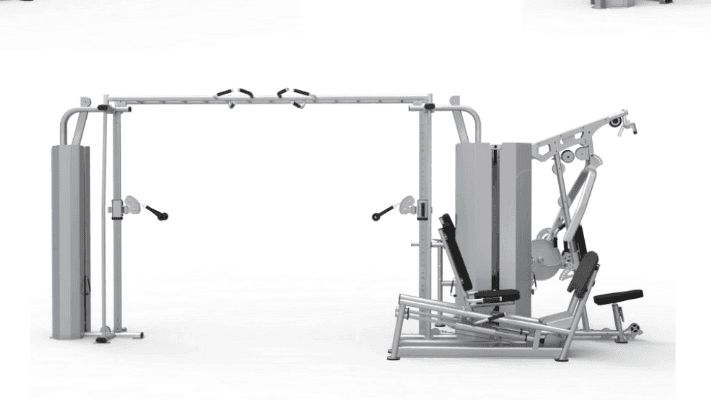
A cable crossover is the classic wide commercial station: two tall columns set far apart, often 6 to 8 feet, connected by an overhead beam with a pull-up bar. That wide stance is built for the crossover and fly movements it is named for, giving an exceptional stretch across the chest. Its pulleys usually have just a few fixed positions, and it commonly runs a 1:1 ratio for a full-stack feel. It needs a lot of floor width, which makes it a staple of commercial gyms and large home spaces rather than tight rooms.
Single cable column
A single cable column, or cable tower, is one upright with one stack and one adjustable pulley. It is compact and affordable, and it handles most single-arm and pulldown work well, which makes it a fine choice for a small home gym or a personal-training studio. The main limitation is that a single cable cannot perform true two-arm movements like a proper cable chest fly, so many buyers eventually want the second stack of a functional trainer.
Multi-station cable machine
A multi-station machine combines several cable stations in one large frame, often a lat pulldown, a low row, a pec fly, and a crossover, sometimes with an assisted chin and dip station. Built for commercial floors and busy facilities, these let several people train at once on different exercises. They are large and expensive, and overkill for most homes, but unmatched for training many users in a shared space.
All-in-one rack systems
One of the fastest-growing categories, the all-in-one integrates a cable system directly into a power rack, often with a Smith machine as well. You get a squat rack and a full functional trainer in one footprint, with barbell training included, which is why these dominate the home-gym conversation. The appeal is consolidation: three machines for close to the space and price of one, combining heavy barbell work with cable versatility.
Smart and digital cable machines
The newest category replaces the weight stack with digital resistance from electric motors or magnets, controlled by software and paired with a touchscreen. Machines like the wall-mounted and freestanding smart trainers now on the market deliver adjustable digital weight and guided workouts with AI feedback, all in a very small footprint. They are a genuine departure from traditional cables, and because they are the defining cable-machine story of 2026, they get their own section below.
The table gives a quick comparison of the traditional types to help you place them at a glance.
Type | Best for | Key trait |
Functional trainer | All-round versatility in a home or studio | Fully adjustable dual pulleys |
Cable crossover | Dedicated chest work on a large floor | Wide fixed-pulley frame |
Single cable column | Compact, budget home setups | One stack and pulley |
Multi-station | Commercial floors with many users | Several stations in one frame |
All-in-one rack | Home gyms wanting cables plus barbell | Rack, Smith, and cables combined |
Smart / digital | Space-limited, tech-forward home gyms | Motor or magnet resistance with AI |
The Benefits of Cable Machines
Cable machines have earned their place through a rare mix of training quality and practicality. The table summarizes the main benefits, and the prose that follows adds the detail.
Benefit | Why it matters |
Constant tension | Loads the muscle through the full range, building strength and size |
Versatility | Hundreds of exercises for every muscle from one machine |
Joint-friendly | Smooth resistance is gentle on joints, ideal for rehab and longevity |
Safety | No barbell to pin you; release the handle and the load drops |
Space efficiency | Replaces several separate machines in one footprint |
Scalability | Suits beginners and advanced lifters by adjusting weight and angle |
The main benefit is constant tension. Because the cable pulls continuously, your muscle stays loaded through the entire movement, during both the lifting and lowering phases, which keeps it working longer than a free weight often does and supports strong growth. Paired with the ability to pull from any angle, that tension gives cables their enormous versatility: a single machine can train chest, back, shoulders, arms, legs, and core across pushing and pulling patterns, rotation included.
The feel is another draw. Cable resistance is smooth and gentle on the joints, which makes these machines a favorite for physical therapy and injury recovery, and for joint-friendly training as people age. They are safe to use alone, since there is no loaded barbell to trap you, and they scale easily for a nervous beginner and an advanced athlete alike on the same station. Add the space efficiency of replacing several machines with one, and it is easy to see why cables are a fixture in home garages and elite training centers alike.
Cable Machine Exercises by Muscle Group
With the right attachments, a cable machine can train every muscle in your body. Here is a quick tour of the most effective exercises by muscle group, enough to build a complete program. A small change in pulley height often changes the muscle emphasis, so treat each as a family of variations, and keep every rep controlled so the stack never crashes down.
Chest: the cable chest press builds the pecs with help from the shoulders and triceps, and it works from a standing or seated position. The cable fly and crossover isolate the chest through a long arc, and setting the pulleys high or low shifts the emphasis between the lower and upper chest. A single-arm press adds an anti-rotation core demand and exposes left-to-right differences.
Back: the lat pulldown is the signature vertical pull for wide lats, and the seated or standing cable row builds mid-back thickness in the rhomboids and traps. Face pulls hit the rear delts and upper back for posture, while the straight-arm pulldown isolates the lats without the biceps. Single-arm rows and pulldowns improve left-to-right symmetry.
Shoulders: the cable lateral raise keeps constant tension on the side delts far better than a dumbbell, which unloads at the bottom. The cable shoulder press builds overhead strength, and rear-delt flyes with face pulls train the often-neglected rear delts. Front raises and upright rows round out the front delts and traps.
Arms: cable curls keep tension on the biceps through the whole movement, and you can run them single-arm or as hammer curls with a rope for the forearms. Rope or bar pushdowns are the staple triceps builder, and overhead cable extensions stretch and load the triceps long head. The constant tension makes arm work productive even at moderate loads.
Legs: cable squats and reverse lunges train the quads and glutes, while Romanian deadlifts hit the hamstrings, with the cable acting as a counterbalance that keeps your torso upright. Cable pull-throughs build explosive hip extension, while glute kickbacks and hip abduction with an ankle strap isolate the hips without loading the spine. Legs are the one area where you may still want free weights for the heaviest loads.
Core: this is where cables outclass free weights. The cable woodchopper builds rotational power through the trunk and the Pallof press trains anti-rotation stability, while the cable crunch loads the abs directly with real resistance. Because the cable pulls from a fixed point, it mirrors how the core works to resist and produce rotation in sport.
Put those together and a single cable machine covers a full-body program. The sample workout below pulls one movement per pattern into a balanced session you can run without leaving the machine, resting about 90 seconds to 2 minutes between sets.
Exercise | Sets and reps |
Standing cable chest press | 3 sets x 8-12 |
Lat pulldown | 3 sets x 10-15 |
Cable Romanian deadlift | 3 sets x 10-12 |
Cable lateral raise | 3 sets x 12-15 |
Rope triceps pushdown | 3 sets x 10-15 |
Cable woodchopper | 3 sets x 12 each side |
Tips for Getting the Most From a Cable Machine
A few habits separate productive cable training from wasted effort. Control is first: move the weight smoothly in both directions and never let the stack slam down, because a swinging stack takes the tension off the muscle that makes cables worth using in the first place. Use a full range of motion, getting a complete stretch and a strong contraction on every rep, which is where constant tension pays off most.
Treat pulley height as a tool rather than an afterthought. Raising or lowering the pulley changes the line of pull and the part of the muscle you emphasize, so one exercise becomes several with a single adjustment. Brace your core on standing movements to keep your torso stable, and swap attachments to match the job, since the right handle often makes an exercise better. Above all, apply progressive overload over time by adding weight or reps, the same principle that drives any strength gain, and keep your form clean before you chase heavier loads.
Cable Machines vs Free Weights
Cable machines and free weights are partners rather than rivals. Free weights, especially barbells and dumbbells, allow the heaviest loading and build raw strength and power, plus the stabilizer coordination that comes from balancing the weight yourself. Cables answer with constant tension, joint-friendly resistance, clean isolation, and the anti-rotation and rotational work that free weights cannot easily replicate. They also make some exercises, like the lat pulldown and triceps pushdown, far more practical than any free-weight substitute.
The strongest training setups use both. Heavy compound lifts with free weights build the foundation of size and strength, while the cable machine handles controlled volume and the isolation or movement patterns barbells miss. Rather than choosing one, most well-equipped gyms give you access to each, and many all-in-one machines now put both in a single frame.
The 2026 Shift to Smart Cable Machines
The biggest change to the category in years is the rise of smart cable machines. Rather than a stack of steel plates, these systems create resistance with electric motors or electromagnets, controlled by software and delivered through cables you pull just as you would on a traditional machine. The result is digital weight: resistance you set on a screen and adjust in tiny increments, without touching a pin or a plate.
This unlocks abilities a steel stack cannot match. Because software controls the load, these machines offer training modes like eccentric overload, where the lowering phase is made heavier than the lifting phase, and chain or accommodating resistance that increases through the range. Many pair cameras and sensors with AI to watch your form and correct it in real time, and to suggest weight changes on their own, which is useful for beginners and anyone training without a coach. Guided workouts and class libraries turn the machine into a personal trainer as much as a piece of hardware.
The other big draw is size. Smart machines are built for modern homes, either wall-mounted or as compact freestanding units that fold away, often occupying only 40 to 50 square feet of working space and storing in a closet. A single unit can stand in for a cable crossover and a functional trainer, plus a guided workout platform, which is a powerful pitch for apartments and small spaces. The category is growing fast, part of a home-fitness market that industry forecasts expect to expand from roughly 12 billion dollars in 2025 toward nearly 20 billion by 2035, with smart and multifunction equipment leading the way.
Feature | Traditional cable machine | Smart digital cable machine |
Resistance source | Steel weight stack or plates | Electric motors or magnets |
Weight changes | Move a pin or load plates | Set on a screen, fine increments |
Special modes | None beyond the stack | Eccentric, chain, and other modes |
Coaching | None built in | AI form feedback and guided workouts |
Footprint | Medium to large | Compact, often wall-mounted or folding |
Ongoing cost | None after purchase | Often a monthly subscription |
For all the appeal, smart machines come with trade-offs worth weighing. Many rely on a monthly subscription, and some lose much of their functionality without it, so the true cost runs well past the sticker price over several years. Resistance ceilings, while high enough for most people, can fall short for very strong lifters, and you are buying into a software ecosystem that must be maintained. The honest take from many reviewers is that a smart cable machine is an excellent fit for a space-limited, tech-forward home, but that a traditional stack machine or a quality rack and free weights still deliver more raw capability per dollar. Smart features should enhance solid training rather than paper over the fundamentals.
How to Choose a Cable Machine
The right machine depends on your space, your budget, and how you train. Work through the factors below and you will avoid the most common buyer's regrets.
Start with the type
Your first decision is the category, since it does most of the work. Choose a functional trainer for all-round versatility in a reasonable footprint, a cable crossover if you have the width and prioritize chest work, an all-in-one rack if you want barbell training and cables together, or a smart machine if space is tight and you value guided, tech-driven workouts. A single cable column suits the smallest budgets and spaces, while a multi-station unit is for commercial floors.
Cable ratio and stack size
Match the cable ratio to your goal: 1:1 for the heaviest strength work, or 2:1 for finer increments and a longer range, with switchable machines offering both. Then size the resistance to your strength now and your room to grow. On a traditional machine, look for stacks you can upgrade later, ideally at least 150 pounds per side; on a smart machine, check the peak resistance per cable, since some cap lower than a serious lifter needs.
Build quality and attachments
A cable machine is a long-term purchase, so buy the frame once. Favor heavy 11-gauge steel for durability and quality pulleys on good bearings, along with rated aircraft-grade cables, since those are the parts that wear. Confirm which attachments are included, because a machine that ships with a good set of handles and attachments saves you buying them piece by piece, and check the warranty and the brand's support record.
Space and price
Measure before you buy. Account for the machine's footprint plus 2 to 3 feet of clearance on each side, and check ceiling height, since many machines stand 80 to 93 inches tall and need extra room above for a pull-up bar. On price, quality functional trainers generally start around 1,500 to 2,500 dollars, and smart machines often run 2,000 to 4,000 dollars or more before any subscription, with all-in-one racks and premium units climbing higher. The table lays out the rough tiers.
Tier | Typical price | What you get |
Budget | $500 to $1,500 | A single column or a basic plate-loaded cable station |
Mid-range | $1,500 to $3,000 | A quality functional trainer with dual stacks and attachments |
Premium | $3,000 and up | All-in-one racks, commercial units, or high-end smart machines |
Who Should Buy a Cable Machine?
A cable machine fits an unusually wide range of users. For the home gym owner, it is one of the best single purchases available, since one machine covers most of a full-body program without filling the room. For personal trainers and studios, it supports a huge range of clients on one footprint, and for commercial gyms it is a high-traffic mainstay that every member can use safely. Its smooth resistance also makes it a fixture of physical therapy and a strong choice for older adults and anyone training for longevity.
The type should follow the user. Space-limited apartment dwellers gravitate toward smart machines or compact functional trainers, while dedicated lifters lean toward all-in-one racks that add barbell work. Commercial buyers go for multi-station units or full crossovers. The one constant is that almost everyone who trains for general strength and fitness benefits from having cables in the mix, whether traditional or digital.
Space, Setup, and Maintenance
A cable machine is a substantial piece of equipment, so plan its home before it arrives. Give it a stable, level floor, ideally on rubber gym flooring that protects the surface and dampens noise, and leave clearance on each side so you can move freely through wide exercises like flyes and crossovers. Confirm the ceiling is tall enough for overhead and pull-up work, remembering that floor matting adds a few inches that cut into your clearance, and check that the delivery path through doorways and stairwells can handle a heavy, boxed machine.
Maintenance is modest but worthwhile. Wipe down the frame and upholstery regularly and keep the guide rods and pulleys clean. Inspect the cables now and then for fraying, since cables are the component most likely to need replacing on a heavily used machine. Check that bolts stay snug over time and that the pulleys glide smoothly. Smart machines add a software dimension: keep the firmware updated and be aware that, unlike a steel stack, a digital system depends on electronics and a connection to work at its best. Treated well, a quality cable machine lasts many years, which is a large part of why it is considered such a sound long-term investment.
Putting It All Together
Cable machines remain one of the most valuable tools in strength training because they do so much so well: constant tension for muscle growth, joint-friendly resistance, spotter-free safety, and hundreds of exercises from a single station. The category spans compact functional trainers, wide crossovers, single towers, multi-station rigs, all-in-one racks, and now a fast-growing wave of smart digital systems, so there is a cable machine for nearly every space and goal, at nearly every budget.
To choose well in 2026, start with the type that fits your space and training, then weigh cable ratio, resistance, build quality, and attachments. From there, decide whether smart features and their subscriptions earn their place for you. For most home and studio gyms, a quality functional trainer is still the most versatile and practical pick, while smart machines make a compelling case where space is tight and guidance is welcome. Whichever you choose, a cable machine will earn its place for years of training.
Cable Machines FAQs
What is the best type of cable machine for a home gym?
For most home gyms, a functional trainer is the best choice, because its fully adjustable pulleys deliver hundreds of exercises in a compact footprint. If you also want heavy barbell training, an all-in-one rack that combines a cable system with a power rack is worth the extra space and cost. For very tight or tech-forward spaces, a smart digital machine packs a lot into a small footprint.
What is the difference between a functional trainer and a cable crossover?
The main differences are pulley adjustability and width. A functional trainer has compact, fully adjustable pulleys that swivel to many angles, so it does hundreds of exercises, while a cable crossover is a wider machine with a few fixed pulley positions, built mainly for chest flyes. The functional trainer is the more versatile and space-efficient choice; the crossover excels at wide chest work on a large floor.
Are smart cable machines worth it in 2026?
They can be, depending on your priorities. Smart machines deliver digital resistance and guided workouts with AI form feedback, all in a very small footprint, which is excellent for space-limited, tech-forward homes. The caveats are subscription costs that add up over time and resistance ceilings that may not satisfy very strong lifters. For raw capability per dollar, a traditional machine or a rack and free weights often still win, so match the choice to what you value.
Can you build muscle with a cable machine?
Yes, and effectively. The constant tension of a cable keeps the muscle loaded through the full range of motion, which drives strong activation and growth, and many lifters find cable curls and flyes better than dumbbells for hypertrophy. With enough resistance and progressive overload, a cable machine builds muscle across the whole body, though very strong lifters may still add free weights for the heaviest lower-body work.
What cable ratio should I look for?
It depends on your goal. A 1:1 ratio gives you the full stack weight and suits heavy strength training, while a 2:1 ratio gives you about half the weight with finer increments and a longer range of motion, which suits high-rep work and rehab, plus taller lifters. Some machines let you switch between the two and give you the strengths of both. Always check the ratio, since it changes how the same stack number feels.
How much space does a cable machine need?
It varies by type. A functional trainer typically needs a footprint a few feet wide and deep plus 2 to 3 feet of clearance on each side, landing around 8 by 10 feet of usable space, while a cable crossover needs far more width. Smart machines are the most compact, often wall-mounted or folding into 40 to 50 square feet. Always check ceiling height too, since many machines are tall and need room above for pull-ups.
Do cable machines come with attachments?
Most do, at least a basic starter set of handles and a rope, plus a bar, though the exact selection varies by model and price. Since attachments are what unlock the machine's full exercise range, it is worth confirming what is included and budgeting for a few extras like ankle straps or a longer lat bar. A good attachment set can add dozens of exercises to any cable machine.
Trending Now
Single Pulley vs Dual Pulley Systems: Which Cable Setup Is Right for You?
Weight Stack vs Plate-Loaded Cable Machines: A Comparison
Newsletter
Enter your email and be the first to get the latest blog posts, news, product launches and more from BodyKore.
Stay in the Know
Enter your email and be the first to get the latest blog posts, news, product launches and more from BodyKore.