

Key Takeaways
The core difference. A weight stack has built-in plates you select with a pin; a plate-loaded machine uses weight plates you load yourself.
Convenience. A weight stack changes weight in seconds with a pin, which is ideal for supersets and circuits, while plate-loaded means loading and unloading plates.
Cost. Plate-loaded machines are cheaper up front if you already own plates; weight stacks cost more for the built-in convenience.
Maximum load. Plate-loaded machines load far heavier, while a weight stack is capped at its built-in maximum unless you upgrade it.
Space. A weight stack is self-contained but heavy and hard to move; a plate-loaded machine is lighter but needs plate storage nearby.
Bottom line. Choose a weight stack for convenience and quick changes; choose plate-loaded for value and heavy loading, especially if you own plates.
Once you have decided to buy a cable machine or functional trainer, one question quickly follows: weight stack or plate-loaded? It comes down to how the machine holds its resistance, either as a built-in stack of steel plates you select with a pin, or as a loading horn where you add your own weight plates. That choice affects what you pay, how you train, and how much you can lift, so it is worth getting right.
Neither system is better across the board. A weight stack is fast, clean, and convenient, while a plate-loaded machine is cheaper up front and can load far heavier. This guide breaks down how the two differ across cost, convenience, maximum load, space, and feel, then helps you match the right one to your budget, your space, and the way you like to train.
What Each System Is
Both systems drive the same cables and pulleys; they differ only in where the resistance comes from. That single difference shapes cost, convenience, and how heavy you can go.
Weight stack (selectorized) machines
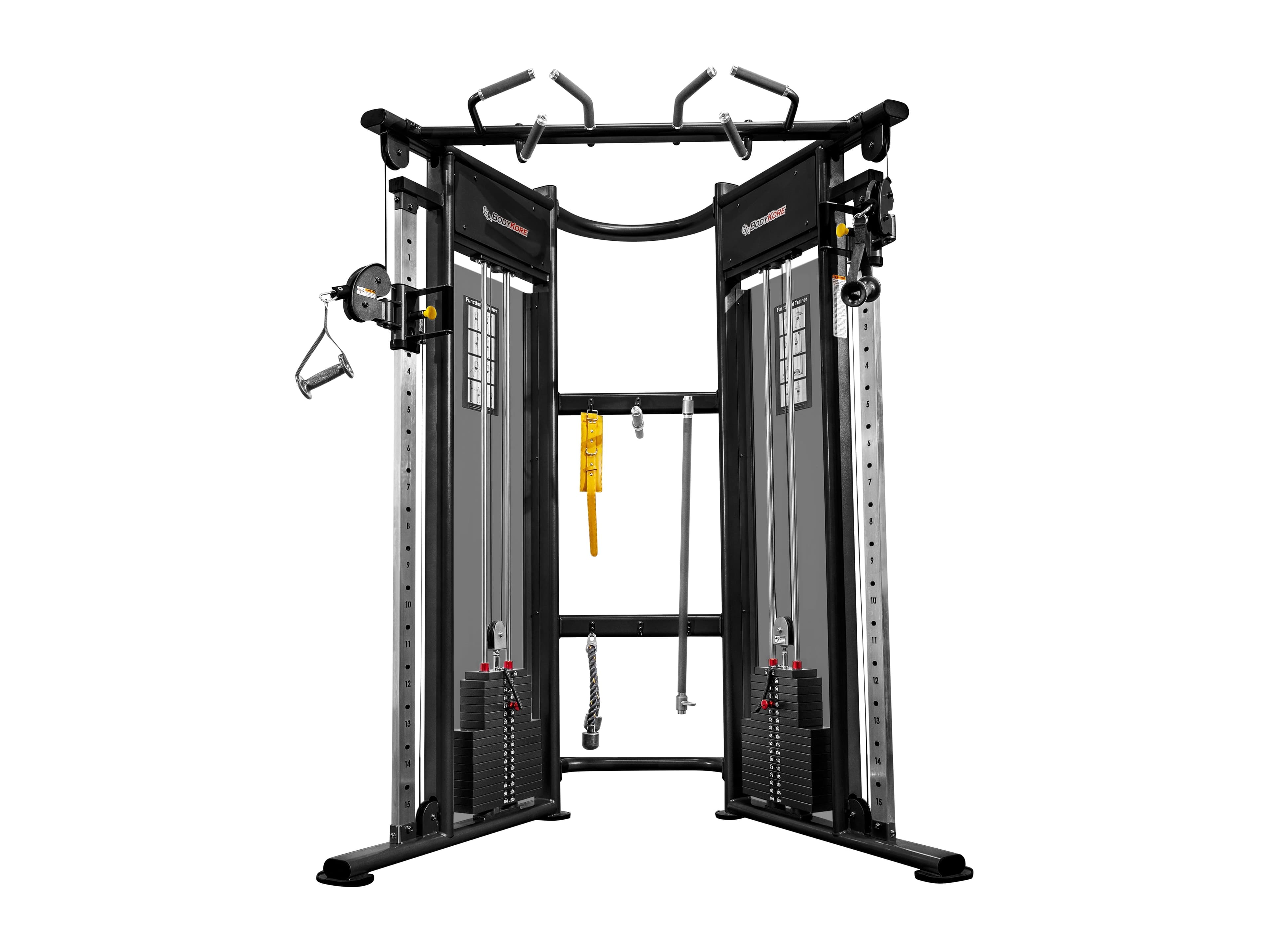
A weight stack machine, also called a selectorized machine, has a built-in column of steel plates threaded onto guide rods. You change the resistance by moving a selector pin to the weight you want, and the cable lifts everything above the pin. This is the style most people picture from commercial gyms, because it is fast, clean, and consistent. The weights are part of the machine, so there is nothing to load, nothing to store, and no clutter around the station. The guide rods keep the plates aligned for a smooth, even pull on every rep.
Plate-loaded machines
A plate-loaded machine has one or more weight horns, essentially posts, onto which you slide your own Olympic weight plates, the same ones you would load onto a barbell. The cable and pulley system then transfers that load to your movement. Because the resistance comes from plates you already own, the machine itself costs less, and you can load it as heavy as the horns and cables allow. The trade-off is that you have to load and unload plates as you change weight, and you need those plates on hand and stored somewhere close by.
Weight Stack vs Plate-Loaded, Head to Head
The table sums up the matchup, and the sections below explain what each row means in practice.
Factor | Weight stack | Plate-loaded |
Weight change | Move a pin, done in seconds | Load and unload plates by hand |
Upfront cost | Higher, weights are built in | Lower, if you already own plates |
Maximum load | Fixed by the stack, often 150 to 225 lb per side | Very high, limited only by the horns and cables |
Increments | Fixed per plate, micro-pins available | Flexible, any plate combination |
Clutter and storage | Self-contained, no loose plates | Needs plate storage nearby |
Machine weight | Heavy, meant to stay put | Lighter to ship, assemble, and move |
Best for | Convenience, supersets, quick sessions | Budget, heavy loading, garage gyms |
Weight changes and convenience
This is the weight stack's biggest advantage. Changing resistance takes a second: pull the pin, drop it into a new hole, and keep training. That speed is a real benefit for drop sets, supersets, and circuits, where you want to change the load without breaking your rhythm, and it makes a shared or commercial station move much faster between users. A plate-loaded machine asks you to physically add or remove plates every time you change the weight, which is slower and interrupts your pacing. If you value a smooth, uninterrupted flow through your workout, the weight stack wins here easily.
Cost and value
Cost is the plate-loaded machine's headline strength, but with an important condition. Because it has no built-in weights, a plate-loaded machine costs noticeably less up front than a comparable selectorized model, and it lets you put your existing plate collection to work. The catch is that this only holds if you already own enough plates. If you have to buy a full set of plates to feed the machine, plus somewhere to store them, the price gap narrows quickly. A weight stack costs more because you are paying for the built-in weights and the convenience they bring, which many people find worth it.
Maximum load and increments
For heavy lifters, this is where plate-loaded pulls ahead. A weight stack is capped at whatever the built-in stack provides, commonly somewhere between 150 and 225 pounds per side on a home functional trainer, and once you reach the top plate you are done unless you pay to upgrade the stack. A plate-loaded machine, by contrast, keeps going as long as you keep adding plates, with weight horns often rated well past 500 pounds, so strong lifters rarely max it out on heavy pushdowns or rows. Plate-loaded systems also give you flexible increments, since you can combine any plates you own, including small fractional plates for tiny jumps. A weight stack moves in fixed increments set by the plate size, though many now include small add-on micro-weights to bridge the gaps.
Space, storage, and portability
Space plays out in two directions. A weight stack is fully self-contained, so there are no loose plates to store or trip over, which keeps the training area tidy. The downside is that the built-in stack makes the machine heavy and bulky, so it is meant to be installed once and left in place. A plate-loaded machine is usually lighter and easier to ship, assemble, and move, since the heavy part, the plates, comes off, but you do need a plate rack or storage nearby to hold them. In a tight space, the plate-loaded unit can be more compact, as long as you have somewhere sensible to keep the plates.
Feel, consistency, and maintenance
Both systems deliver the smooth, constant cable tension that makes these machines effective, but there are small differences. A weight stack running on guide rods tends to feel consistent and even through the whole movement, and its enclosed design is low-maintenance and safe around children. A well-built plate-loaded machine feels just as smooth, though a poorly designed one can deliver slightly uneven resistance at the top or bottom of a movement, depending on how the plates and pivots are arranged. Plate-loaded mechanisms are simple and durable, with the main upkeep being your own plates, while a weight stack has more enclosed moving parts but rarely needs attention.
Which Should You Choose?
The right pick depends on your budget, how heavy you lift, and how you like your training space to feel. Match the system to your priorities rather than to a spec sheet, and the decision gets simple.
Choose a weight stack if: you want fast weight changes for supersets and circuits, prefer a clean and clutter-free station, do not already own plates, or value grab-and-go convenience over saving money.
Choose plate-loaded if: you are on a budget, already own a set of plates, want to load very heavy, need a lighter machine you can move, or like flexible weight increments.
For most home gym owners who already own a barbell and plates, a plate-loaded cable machine offers excellent value and all the load you will ever need. For those who prioritize convenience, train with supersets and drop sets, or do not want a pile of plates around the machine, a weight stack is worth the higher price. Commercial gyms almost always choose weight stacks for their speed and low upkeep across many users. If you mostly want quick, clean sessions, lean toward a stack; if you want value and heavy loading, lean plate-loaded.
Hybrid and Conversion Options
You are not always locked into one system. Some machines are sold in both selectorized and plate-loaded versions of the same frame, so you can pick the format that suits you, and a number of manufacturers offer conversion kits that let you start with one and switch later. That makes it easier to begin plate-loaded on a budget and add a weight stack down the line if you decide you want the convenience.
There is also a clever middle path for weight stacks that feel too light. A loading-pin accessory lets you hang extra Olympic plates off the selector pin, adding resistance beyond the built-in maximum. It is a handy way to push past a stack's ceiling, but use it carefully and check the machine's rated cable capacity first, since overloading the cable past its tensile strength can cause it to fail.
Putting It All Together
Weight stack and plate-loaded cable machines both deliver the constant-tension training that makes cables so valuable; they simply get there differently. A weight stack trades a higher price and a fixed weight ceiling for speed, cleanliness, and grab-and-go convenience, which is why it rules commercial floors and suits anyone who wants quick, uninterrupted sessions. A plate-loaded machine trades slower weight changes and the need to store plates for a lower price and near-unlimited loading, which makes it a favorite of budget-minded and strength-focused home gym owners who already have plates.
Decide by your priorities. Pick a weight stack for convenience and fast changes, and plate-loaded for value and heavy loading, and remember that hybrids and conversion kits can give you a foot in both camps. For a home gym built around an existing plate collection, plate-loaded is usually the smarter value; for a clean, fast, low-maintenance station, a weight stack earns its higher price.
Frequently Asked Questions
Is a plate-loaded or weight stack cable machine cheaper?
A plate-loaded machine is usually cheaper up front, because it has no built-in weights, but only if you already own plates. If you have to buy a full set of plates and a rack to store them, the savings shrink. A weight stack costs more because the weights are built in, which is part of what you are paying for along with the convenience. For someone who already owns plates, plate-loaded is the clear value pick.
Which is better for heavy lifters?
Plate-loaded machines are better for very strong lifters, because you can keep adding plates well past what a built-in stack offers. A home weight stack often caps somewhere between 150 and 225 pounds per side, which can feel limiting on heavy pushdowns or rows, while plate-loaded horns are frequently rated past 500 pounds. If maximal loading matters to you, plate-loaded is the safer long-term choice.
Can you add weight beyond a weight stack's maximum?
Often, yes. Many stacks accept a loading-pin accessory that lets you hang extra Olympic plates off the selector pin to push past the built-in maximum. It is a useful trick, but check the machine's rated cable capacity first, because loading beyond the cable's tensile strength can cause it to snap. Used within the machine's limits, it is a simple way to add resistance without upgrading the whole stack.
Which system is better for a small home gym?
It depends on your plates. A plate-loaded machine tends to have a more compact, lighter frame, which suits a small space, but you still need somewhere to store the plates. A weight stack takes up a fixed footprint with no loose plates to store, though the machine itself is heavier and bulkier. If you already have a plate rack, plate-loaded can save space; if not, the self-contained stack keeps things tidy.
Are weight stack machines better for supersets and circuits?
Yes. The pin selector on a weight stack lets you change resistance in a second, which is ideal for drop sets, supersets, and fast circuit training where stopping to load plates would break your rhythm. This speed is also why commercial gyms favor weight stacks, since it keeps a shared station moving quickly between users. For high-paced training, the weight stack has a clear edge.
Can you convert a plate-loaded machine to a weight stack?
Sometimes. A number of manufacturers sell conversion kits or offer the same machine in both formats, so you can start with one system and switch later. This lets you buy plate-loaded on a budget now and add a weight stack for convenience down the road. Check whether your specific model supports a conversion before assuming it does, since not every machine is built for it.
Trending Now
Single Pulley vs Dual Pulley Systems: Which Cable Setup Is Right for You?
Cable Machines: The Complete Guide
Newsletter
Enter your email and be the first to get the latest blog posts, news, product launches and more from BodyKore.
Stay in the Know
Enter your email and be the first to get the latest blog posts, news, product launches and more from BodyKore.