

Key Takeaways
The core difference: a single pulley uses one cable and one weight stack; a dual pulley uses two cables, ideally with two independent stacks.
Cable ratio: single pulleys usually run a 1:1 ratio so you feel the full weight, while dual pulleys often run 2:1 for half the weight and double the cable travel.
Exercise variety: a dual pulley handles two-arm moves like flyes and crossovers plus unilateral work; a single pulley focuses on one cable at a time.
Fixing imbalances: independent dual stacks force each side to carry its own load, which a single line of resistance cannot do.
Heavy pulling: a single pulley's 1:1 feel is better for loading up lat pulldowns and rows heavily.
Bottom line: choose single for budget and space, and for heavy back work; choose dual for versatility and balanced, functional training.
When you shop for a cable machine, one choice shapes everything else: single pulley or dual pulley. It sounds like a small detail, but the number of cables changes the resistance you feel and the exercises you can perform, along with how well the machine fixes imbalances. Get it right and the machine matches how you train. Get it wrong and you end up frustrated or paying for capability you never use.
The short version is that a single pulley system is simpler and cheaper, and better for heavy pulling, while a dual pulley system is more versatile and better for balanced, functional training, which is why functional trainers are so popular. This guide explains how the two differ, clears up a common point of confusion, and helps you decide which belongs in your gym.
What Each System Is
Both systems use the same basic parts, a cable and a pulley connected to a weight source, but the number of cables changes how the machine behaves. Here is what separates them.
Single pulley systems
A single pulley system uses one cable running over one pulley, attached to one weight stack. You work one line of resistance, so the weight you select is the weight you pull. This makes single pulley machines straightforward and predictable, and they are the basis of dedicated stations like the lat pulldown and the seated row, as well as simple adjustable cable columns. They handle any exercise that uses a single cable well, including two-handed movements like a triceps pushdown or a rope face pull, and single-arm work of all kinds.
Dual pulley systems
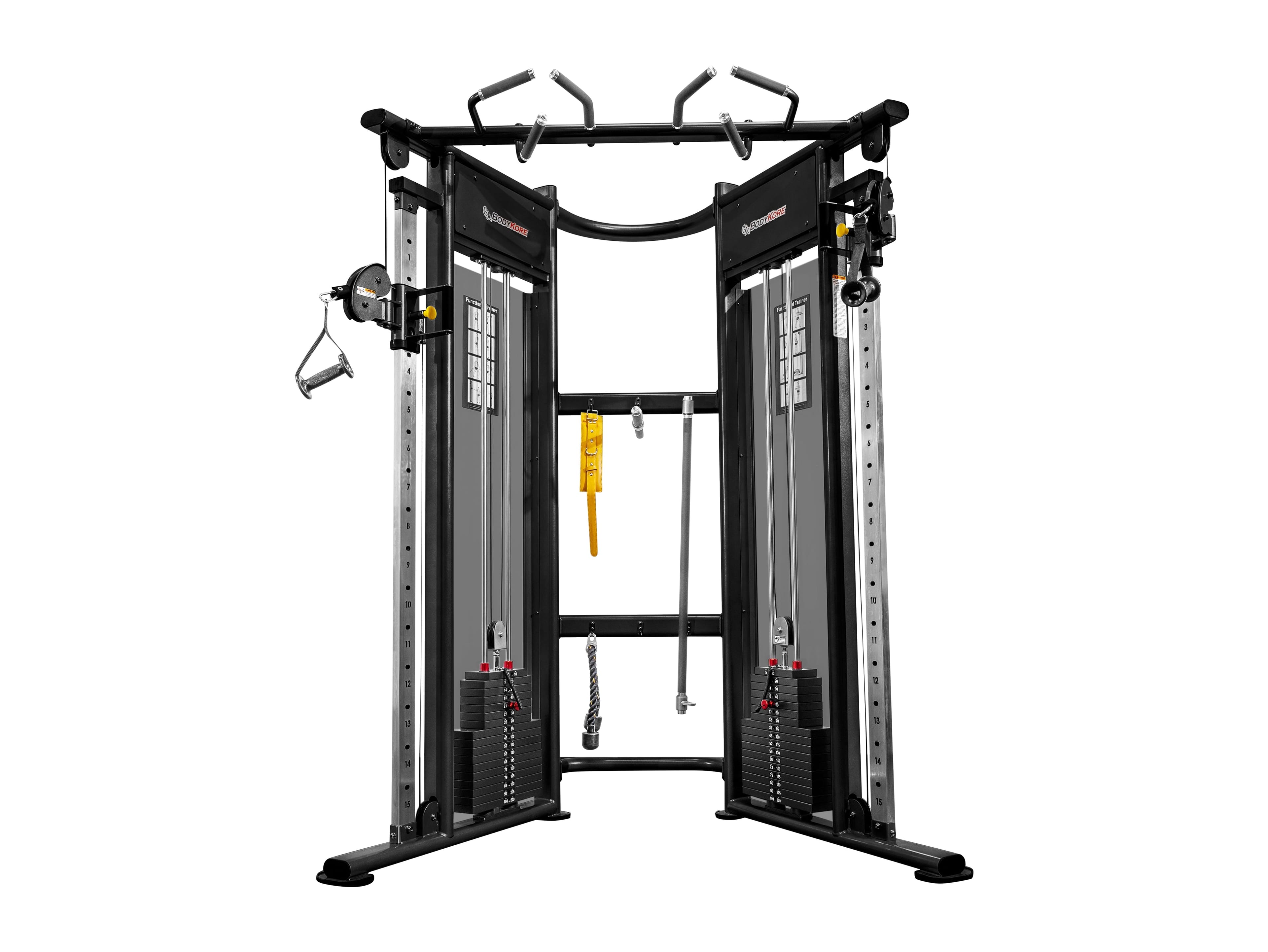
A dual pulley system uses two cables, each with its own pulley, mounted on two columns. In the best versions, each cable has its own independent weight stack, which is what defines a true dual stack functional trainer. That second cable and stack transform what the machine can do: you can train both sides at once for movements like cable flyes and crossovers, or work each arm on its own and alternate between them, all without moving your body or the equipment. This is the setup that gives functional trainers their reputation for versatility.
A common point of confusion
It is worth clearing up a mix-up that trips up a lot of buyers. Not every two-cable machine has two independent stacks. Some double pulley machines run two cables off a single shared stack, which lightens the load and adds cable travel but lets a stronger side help a weaker one during two-arm movements. That is different from a true dual stack, where each side is fully independent. Equally, two separate single pulley machines placed side by side are not the same as one dual pulley system, because the resistance behaves differently. When versatility and balanced training matter, what you want is two cables with two independent stacks.
The Cable Ratio Connection
The single-versus-dual question is tied closely to cable ratio, which is why the two often get discussed together. A single pulley usually runs a 1:1 ratio: pin 100 pounds and you pull against 100 pounds, with the cable moving the same distance as the stack. That direct, full-weight feel is ideal for heavy, slow strength work like lat pulldowns and low rows.
A dual pulley system typically runs a 2:1 ratio, where the weight you feel is about half the stack. Pin 100 pounds and each hand pulls against roughly 50, but the cable travels twice as far, which suits the faster, longer-range movements functional training is built on. The trade-off is that a 2:1 dual setup can cap out sooner for very strong lifters, since a 200-pound stack feels like only 100 pounds per hand. Some machines include a connector that combines the two cables into a 1:1 setup for heavy pulling, giving you both options.
Single Pulley vs Dual Pulley, Head to Head
The table lays out the matchup at a glance, and the sections below explain what each row means for your training.
Factor | Single pulley | Dual pulley |
Setup | One cable and one weight stack | Two cables, ideally two independent stacks |
Cable ratio | Usually 1:1, you feel the full weight | Usually 2:1, half the weight and double travel |
Best exercises | Heavy pulldowns, rows, and pushdowns | Flyes, crossovers, presses, and unilateral work |
Fixing imbalances | Limited to one line of resistance | Strong; each side loads independently |
Heavy load feel | Higher, better for maximal pulling | Lower per hand; can cap out sooner |
Two people at once | No | Yes, with independent stacks |
Footprint and cost | More compact and affordable | Wider and more expensive |
Exercise variety
This is where the dual pulley pulls ahead. With two cables, you can perform the whole family of two-arm movements that need resistance from both sides at once, including cable flyes and crossovers, plus bilateral presses, alongside every single-arm exercise. A single pulley can only work one cable at a time, so while it handles pushdowns, face pulls, curls, rows, and unilateral movements well, it cannot produce a true two-arm cable fly or crossover on its own. If exercise variety is your priority, the dual pulley wins clearly.
Fixing imbalances and independent loading
A dual pulley system with independent stacks is one of the best tools available for correcting side-to-side imbalances. Because each side has its own resistance, your weaker side has to carry its own weight rather than letting the stronger side take over, which is what happens with a shared load. Over time, that evens out asymmetries and improves your mind-muscle connection, which builds more balanced strength. A single pulley, working one line of resistance, cannot offer the same independent loading, though it still allows single-arm training one side at a time.
Heavy pulling and maximal strength
Here the single pulley has the edge. Its 1:1 ratio means you feel every pound, which is what you want for loading a lat pulldown or a low row heavily, and dedicated single-stack stations often add leg rollers or foot plates to anchor you against serious weight. A dual pulley's 2:1 ratio halves the felt resistance per hand, so a strong lifter can run out of stack on heavy pulls sooner than expected. For pure maximal pulling strength, a single pulley setup is usually the better fit.
Core and stabilization
Managing two independent cables asks more of your body than a single locked line does. On a dual pulley, your core and stabilizing muscles have to control two separate loads and keep you balanced, especially during alternating or single-arm work, which adds a functional training demand that carries over to sport and daily movement. A single pulley is more stable and predictable, which is easier to learn on but asks less of your stabilizers. Whether that is a pro or a con depends on your goals.
Space and cost
On the practical side, single pulley systems are the lighter commitment. They are generally more affordable and often more compact, though the floor space needed for the two is closer than you might expect, since both need room to move. Single systems also have fewer moving parts, which means less to maintain over time. A dual pulley packs far more functionality into a similar footprint, but with twice the cables and pulleys, plus two stacks, it costs more up front and has more components to look after. For a tight budget or a simple setup, single wins on cost and simplicity; for capability per square foot, dual wins.
Which Should You Choose?
The right choice comes down to how you train, plus your budget and space. The two systems reward different priorities, so match the setup to your plan rather than to the spec sheet.
Choose a single pulley if: you are on a budget, have tight space, focus on heavy back work like pulldowns and rows, or mostly do single-cable and unilateral exercises.
Choose a dual pulley if: you want maximum exercise variety, care about fixing imbalances, train functional and rotational movements, or want one machine that does nearly everything.
For most home gym owners who want a single versatile machine, a dual pulley functional trainer is the stronger long-term choice, because it does everything a single pulley does and adds two-arm movements and independent loading, plus functional variety. A single pulley makes the most sense when your budget or space is tight, or your training centers on heavy pulling, and it is also a smart accessory station in a gym that already has other cable options. If you mostly chase a bigger, heavier back, lean single; if you want to do a bit of everything, lean dual.
Hybrid and Switchable Options
You do not always have to pick one. A growing number of machines are built to give you both, either by letting you configure a single or dual stack setup, or by including a connector that combines two 2:1 cables into a single 1:1 line for heavy pulling. Some rack-mounted systems provide independent cables for unilateral work and center attachment points for heavy bilateral pulldowns and rows, so you get the functional variety of a dual pulley and the maximal-load capability of a single pulley in one frame.
These hybrids cost more and add complexity, but for a lifter who wants the versatility of a dual pulley without giving up heavy pulling, they can be the smartest buy. If you are torn between the two systems and your budget allows, a switchable or hybrid machine sidesteps the whole decision by delivering both.
Putting It All Together
The single-versus-dual pulley choice is really about how you weigh two things: heavy pulling versus all-round versatility. A single pulley system keeps it simple and direct, with a 1:1 ratio that excels at loading pulldowns and rows, plus a smaller price tag and fewer parts to maintain. A dual pulley system, especially one with two independent stacks, opens up two-arm movements and independent loading that fixes imbalances, plus the functional variety of a much bigger setup, in exchange for a higher price and a 2:1 ratio that caps heavy loads sooner.
Decide by your training. Pick a single pulley for a simple, affordable setup and serious back work, and a dual pulley for variety and balanced, functional strength. And if you would rather not choose, a hybrid machine gives you both. For most people building one versatile cable station, the dual pulley is the more complete and future-proof pick, which is why so many modern home and commercial gyms are built around it.
Frequently Asked Questions
What is the difference between a single and dual pulley cable machine?
A single pulley machine uses one cable and one weight stack, while a dual pulley machine uses two cables, ideally with two independent weight stacks. The single setup usually runs a 1:1 ratio for heavy pulling, and the dual setup usually runs 2:1 for more cable travel and greater exercise variety. The dual system can perform two-arm movements like flyes and crossovers that a single cable cannot.
Is a dual pulley harder than a single pulley?
In some ways, yes. A dual pulley's 2:1 ratio makes the felt weight per hand lighter, but managing two independent cables demands more from your core and stabilizing muscles, and it exposes side-to-side weaknesses a single fixed line hides. So while the raw weight can feel lighter, the movement often demands more control and coordination. Many lifters find dual pulley training more challenging in that sense.
Can you do cable flyes on a single pulley machine?
Not a true two-arm cable fly, no. A proper fly or crossover needs resistance pulling from both sides at once, which requires two cables. On a single pulley, you can perform a single-arm fly one side at a time, which is a useful exercise in its own right, but it is not the same as the simultaneous two-arm movement. If flyes and crossovers are a priority, you want a dual pulley system.
Which is better for lat pulldowns, single or dual pulley?
A single pulley is usually better for heavy lat pulldowns. Its 1:1 ratio lets you feel and load the full weight, and dedicated single-stack pulldown stations include leg rollers to anchor you against heavy loads. A dual pulley can do pulldowns too, and offers independent, unilateral loading that helps with imbalances, but its 2:1 ratio and lack of anchoring make it less suited to maximal pulling.
Are two single pulley machines the same as a dual pulley?
No. Two single pulley machines side by side each have their own stack at a 1:1 ratio, so the weight you select is the weight you feel on each. A dual pulley system is engineered as one machine, often with a 2:1 ratio and shared or independent stacks, and it behaves differently in both resistance and cable travel. Do not assume two single stations will replicate a dedicated dual pulley setup.
Which pulley system is best for beginners?
Both work well for beginners, but they suit different starting points. A single pulley is simpler and more predictable, which makes it easy to learn proper form without managing two loads. A dual pulley offers far more exercise variety to grow into and builds coordination and balance from the start. If budget and space allow, a dual pulley functional trainer gives a beginner more room to progress, while a single pulley is a solid, affordable entry point.
Trending Now
Weight Stack vs Plate-Loaded Cable Machines: A Comparison
Cable Machines: The Complete Guide
Newsletter
Enter your email and be the first to get the latest blog posts, news, product launches and more from BodyKore.
Stay in the Know
Enter your email and be the first to get the latest blog posts, news, product launches and more from BodyKore.