

Fitness enthusiasts, listen up. If you want to build serious leg strength and a powerful core, squats are your go-to exercise. But here’s the thing: not all squats are created equal. Hack squats and barbell squats might seem similar, but they hit your muscles differently and serve different purposes.
Not all squats are built the same. The right choice depends on what you want to achieve, how comfortable you are with technique, and the tools at your disposal.
We’re breaking down hack squats versus barbell squats, covering how they work, their benefits and drawbacks, and who should be doing each. By the end, you’ll know exactly which one fits your game plan. Let’s get started.
What is a Hack Squat?
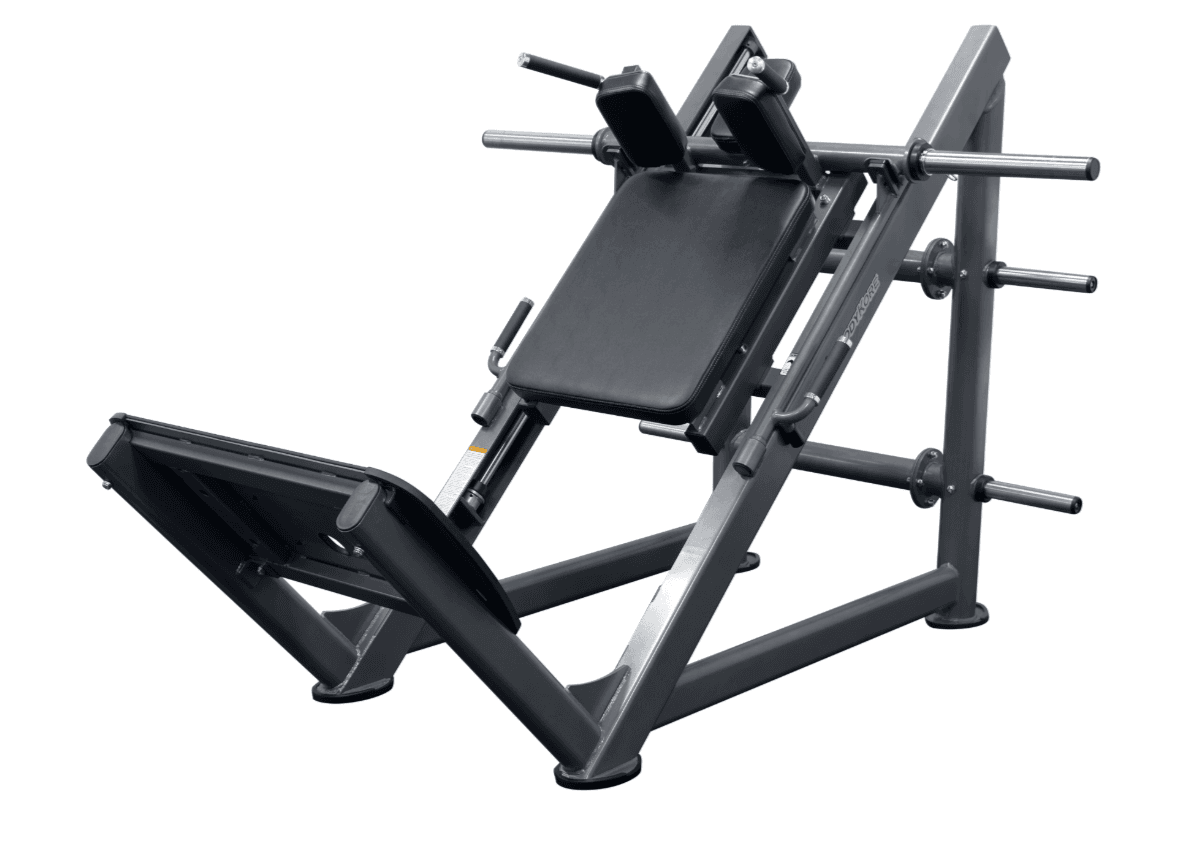
The hack squat is a machine exercise mainly designed to target your quadriceps (the front thigh muscles). You place your back against a fixed pad and your feet on a platform connected to a weighted sled that moves up and down on a set track. Because the machine controls the movement, you don’t need to use many stabilizer muscles to make the motion more controlled and focused.
These will make hack squats great for building strong quads, especially if you’re new to squats or want to avoid straining your lower back compared to regular barbell squats.
When doing it, you keep your back flat, shoulders hooked under the pads, and knees pushed out in line with your toes. Moving slowly and steadily without bouncing helps get the most from your muscles.
How to Perform a Hack Squat?
-
Position yourself with your back firmly against the machine’s back pad.
-
Place your feet shoulder-width apart (or adjusted to your preferred stance) on the foot platform.
-
Hook your shoulders securely under the machine’s shoulder pads.
-
Keep your back flat and chest up throughout the movement.
-
Slowly bend your knees to lower yourself down, pushing your hips back slightly while keeping your knees aligned with your toes.
-
Lower until your thighs are roughly parallel to the foot platform or as far as your mobility allows without discomfort.
-
Push through your heels to extend your legs and return to the starting position.
-
Maintain control during the entire movement—avoid bouncing at the bottom to maximize muscle engagement.
Variations You Can Try
-
Foot position:
-
Higher on the platform works your glutes and hamstrings more
-
Lower targets the inner part of your quads
-
-
Stance width:
-
Narrow stance hits the front quad more
-
A wide stance activates your inner thighs
-
-
Tempo and pause: Holding at the bottom or slowing the movement increases muscle tension for better growth.
-
Single-leg hack squats: Help fix strength imbalances and improve balance.
-
Reverse hack squat: Facing the machine the other way shifts focus more to your glutes and hamstrings.
Besides the machine, you can do a barbell hack squat (holding the barbell behind your legs) or use a Smith machine for a similar quad workout with different challenges for your grip and stabilizers.
Pros
-
Guided machine path reduces balance and coordination demands
-
Isolates the quadriceps effectively for targeted muscle growth
-
Safer for beginners or those with limited mobility or lower back issues
-
Easier to load heavy weights without needing perfect form
-
Adjustable foot positions to target different muscles
Cons
-
Limited engagement of stabilizer muscles and core
-
Less functional carryover to real-world movements or sports
-
Machine-dependent requires gym access with the specific equipment
-
Fixed movement pattern limits variation and adaptability
-
Can place unnatural stress on the knees if the technique or setup is off
What is a Barbell Squat?
The barbell squat is a free-weight, compound exercise that targets your quadriceps, glutes, hamstrings, and core. Unlike the hack squat machine, it requires you to balance and stabilize your entire body throughout the movement.
You place a barbell across your upper back either in a high-bar position on your traps or a low-bar position just below the traps on your rear delts.
How to Perform the Barbell Squat?
-
Stand with your feet shoulder-width apart or slightly wider, toes pointed slightly outward at a comfortable angle.
-
Engage your core and keep a neutral spine to protect your back.
-
Begin by bending your hips and knees simultaneously, lowering your body while keeping your chest up and back straight or slightly arched.
-
Squat down until your thighs are parallel to the floor or lower if your mobility allows.
-
Distribute your weight evenly through your feet, pushing through your midfoot and heels, and maintain contact with the floor at your big toe, pinky toe, and heel.
-
Drive upward by extending your hips and knees while maintaining posture until you stand fully upright with hips and knees locked.
Important Notes and Tips
-
Proper technique is essential to avoid injury and maximize muscle activation.
-
Your core and upper back must stay tight to stabilize your spine and maintain balance.
-
Good hip and ankle mobility improves depth and form.
-
Move with control on both the descent and ascent to optimize muscle engagement and strength gains.
Variations You Can Try
-
Front Squat: The Barbell is held across the front of your shoulders. This shifts focus more to your quads and core while reducing stress on your lower back.
-
Box Squat: You squat back onto a box or bench, which helps train proper depth and improves explosive power on the way up.
-
Pause Squat: Hold the bottom position for 1-3 seconds before standing up to increase time under tension and build strength.
-
Sumo Squat: A wider stance with toes pointed further out targets the inner thighs and hips more.
-
Zercher Squat: The Barbell is held in the crook of your elbows. This variation challenges your core and upper back differently while still building leg strength.
-
Overhead Squat: Holding the barbell overhead increases mobility and balance demands and works the entire body.
Pros
-
Engages multiple muscle groups, including quads, glutes, hamstrings, core, and stabilizers
-
Builds functional strength transferable to everyday activities and sports
-
Offers variety with many squat styles and stance options
-
Improves balance, coordination, and core stability
-
Doesn’t require a machine—can be done with basic gym equipment
Cons
-
Requires good technique to avoid injury, especially to knees and lower back
-
Higher risk of injury without proper form and mobility
-
Steeper learning curve, not ideal for absolute beginners without coaching
-
Can be intimidating due to balance and stability demands
-
May require a spotter or safety equipment when lifting heavy
Practical Considerations
Choosing between hack squats and barbell squats isn’t just about muscles and technique. You also need to consider real-world factors that affect your training success.
Equipment Availability
Not every gym has a hack squat machine, but most have barbells and squat racks. If you don’t have access to a machine, barbell squats are your go-to. On the flip side, if you prefer machine workouts or want more controlled movement, a gym with a good hack squat setup is ideal.
Training Goals Alignment
Your goals shape which squat fits best. If you want to isolate and build your quads safely, hack squats can be a perfect choice. But if you’re after overall strength, balance, and athletic performance, barbell squats deliver more bang for your buck by engaging more muscles and stabilizers.
Injury History and Mobility Factors
If you have lower back pain, mobility limitations, or balance issues, hack squats provide support and reduce injury risk thanks to the guided path. Barbell squats demand good hip, ankle, and core mobility, plus proper technique, which may not be suitable if you’re rehabbing or new to squatting.
Which One Should You Choose?
If you’re new to squatting, dealing with lower back issues, or want to focus mainly on building your quads safely, hack squats are a smart choice. They offer stability, reduce injury risk, and help you load weight without worrying about balance or complex technique.
On the other hand, if your goal is to build full-body strength, improve athletic performance, and engage multiple muscle groups, including your core and stabilizers, barbell squats are the way to go. They demand better mobility and form but deliver bigger functional benefits.
Final Verdict
Both hack squats and barbell squats offer clear benefits. Hack squats provide a safe, controlled way to isolate your quads, ideal for beginners or anyone wanting focused muscle growth with less strain. Barbell squats require more technique and stability but deliver full-body strength, improved balance, and functional fitness.
Choose hack squats if you want targeted quad work and extra support. Choose barbell squats to build overall power and athleticism.
Looking to set up your home gym or upgrade your equipment? BodyKore Fitness offers high-quality squat machines, barbells, racks, and more, everything you need to train smart and strong. Check out BodyKore’s range and gear up for your best workouts yet!
Read More: Barbell Squats Alternatives
Trending Now
Single Pulley vs Dual Pulley Systems: Which Cable Setup Is Right for You?
Weight Stack vs Plate-Loaded Cable Machines: A Comparison
Cable Machines: The Complete Guide
Newsletter
Enter your email and be the first to get the latest blog posts, news, product launches and more from BodyKore.
Stay in the Know
Enter your email and be the first to get the latest blog posts, news, product launches and more from BodyKore.