

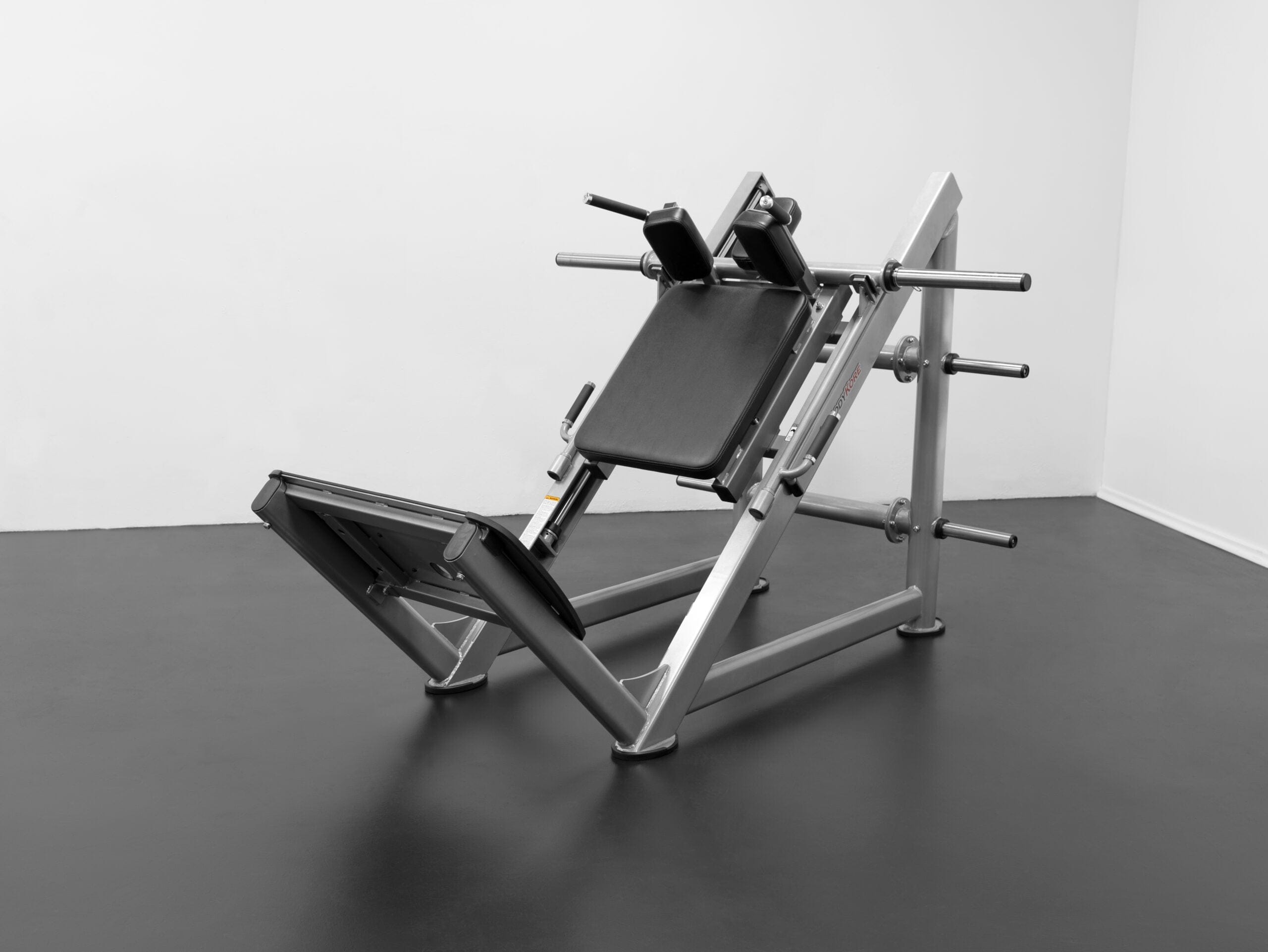
The hack squat machine should be a regular in your leg day program, in case you want to train large, strong quads without ruining your lower back. It provides you with a compound squatting movement, and your spine is supported, making it one of the most effective and most joint-friendly quad builders in the gym.
This manual includes it all: setup, execution, form tips, errors to avoid, which muscles, variants, and how to make it work to achieve real results, whether you are a beginner learning the basics or an experienced lifter trying to finetune your technique.
What Is a Hack Squat?
The hack squat is one such exercise that may appear easy to do at the other end of the gym, but there is much to learn before getting on the machine. Being able to understand what it is and the difference between it and other squat variations will make you more purposeful in using it in your training.
The hack squat is a machine-based compound exercise that is done on an angled sledge, usually with a 45-degree inclination. You strap a weight to the sledge, support your shoulders under padded supports, and put your feet on a footplate and squat along a designated track.
The machine supports your torso, unlike a barbell back squat, and directs your movement path, eliminating the balance requirements of squatting with free weight. This allows you to put almost all your efforts into driving using your legs.
Quadriceps are the main muscles involved, with secondary muscles being the glutes, hamstrings, and calves.
How to Do a Hack Squat (Instructions)
Setting up the setup correctly prior to your initial rep is more important than most individuals believe. The machine may not be properly adjusted, or a slippery starting position will ruin all the succeeding reps. Allow two minutes to get things correctly established, and everything else takes care of itself.
Setting up and positioning of machines
Place a suitable initial weight on the sledge. Fit the shoulder pads so that they fit loosely across your trapezius, not against your neck. Place your back on the pad and place your foot on the footplate.
Foot Placement
Position your feet so that they are shoulder-width apart with toes turned slightly outwards, about 10-15°. The mid-foot position is a neutral position. The height and width of the feet can be adjusted to change the emphasis of the muscles, and this is discussed in the variations section.
Movement Execution
Straighten back, holding the safety handles. Move or twist the safety bars to unlock the sledge. Breathe, tighten your abs, bending at both knees and hips at the same time. Descend at a controlled rate of 2 to 3 seconds, as the thighs come parallel to the footplate or even lower.
Then push with all your feet, not with your toes alone, to push the sledge up again. Only go as far as not to lock your knees on top so that you retain tension on the quads. Once you have completed your last rep, make sure that you rotate the safety handles back into position before getting off.
Breathing Technique
Breathe in and tighten your core, and then jump. Breathe out while driving the sledge uphill. This pressure aids in the safeguard of your spine even within a supported machine setting.
Hack Squat Form Tips for Maximum Results
It is a thing to know the steps. Another is to put them through well in fatigue and real weight. The ones are the form cues that make the difference between a productive set and a wasted set. Remember them next time you are on the machine.
Have a Controlled Tempo
Do not be tempted to hurry along or to bounce. A slow, 2-second descent and a slow, 1 to 2-second rise maintain tension on the muscle in the entire range of motion. This is one of the tension times that are a major motivator of muscle growth.
Support Knees in Line with Toes
Your knees must move in the same direction as your toes at all times of the movement. Look out for an inward drift, particularly at the end of a set when one is feeling tired.
Do not Lock Knees at the top
Complete locking of your knees shifts the weight off the muscle onto the joint. Stop at 5-10 degrees short of full extension, to maintain the quadriceps in continuous tension and safeguard the knee joint in the long term.
Be Involved Core-Wide
Although the pad at the back supports you, bracing your core will give internal stability and strengthen a neutral position of the spine across all the reps.
Depth of Control and Range of Motion
The depth is important, but straining your hips and ankles to go farther than they are ready to will make your lower back come off the pad. Gradually increase mobility instead of attempting to make it happen immediately.
Common Mistakes to Avoid
The vast majority of individuals do not make glaring mistakes on the hack squat; they make minor ones that build up as time goes by and restrain their progress without their knowledge or predisposing them to injury. These are the most frequent matters to observe and rectify at the earliest.
Placing Feet Too High or Too Low Without Intent
Foot position has significant implications for the muscles stressed. Studies prove that the higher the foot position, the more glutes are involved, whereas the lower the foot position, the more quads and calves are involved. None of them are bad, but position your feet intentionally according to what you want to achieve through training instead of placing them in any position.
Using Excessive Weight
Excessive loading places you in the need to sacrifice depth, rounding your lower back off the pad, and lose the ability to track the knee. Develop technical expertise and then load.
Rushing the Movement
The lowering phase is wasted by dropping the sledge in a short time. Slow, controlled eccentrics yield superior hypertrophy results and a greater time under tension when compared to fast, sloppy reps.
Loss of Back Contact with the Pad
The instant your back is moving off the pad, your lumbar spine is supporting weight that it is not supported in this posture. Should this occur, reduce the weight or the range of motion till you are able to move better.
Knee Valgus (Knees Caving In)
Collapsing inward is a form of breakdown as well as a risk of injury to the knees. When this occurs, then the weight is probably excessive, or your glutes and hip abductors require further work outside of the hack squat.
Muscles Worked in Hack Squat
Knowing the muscles really being trained by the hack squat and to what extent will allow you to program it more intelligently amongst the rest of your leg exercises. This is a complete breakdown of what is working in each rep.
Primary Muscles: Quadriceps
The major muscle group in the hack squat is the quadriceps. The quad contains four muscles: vastus medialis, vastus lateralis, vastus intermedius, and rectus femoris. Since the torso is stabilized and the movement is predetermined, in comparison with most other exercises involving the compound leg, the quads are overloaded with the load.
Secondary Muscles: Glutes and Hamstrings
Gluteus maximus and hamstrings help in the extension of the hips in the upward movement, but the contribution is not much compared to a squat using a barbell. EMG studies have confirmed that the glute and hamstring activation during hack squats is less than during barbell back squats exactly what allows them to be such a specific quad exercise.
Stabilizer Muscles: Core and Calves
The core musculature, such as the erector spinae, in relation to the pelvis maintains the spinal position. The gastrocnemius and soleus in the calves help in regulating the descent and propulsion during the ascent.
In a peer-reviewed study, which was published in the Journal of Strength and Conditioning Research, the muscle activity of the trunk during the back squat and the hack squat at the same relative load was investigated. The researchers observed that the trunk muscle activity was much greater in the back squat than in the hack squat, and supported the hypothesis that the hack squat imposes much less load on the spinal muscles and transfers more load to the lower extremities, especially the quadriceps.
Hack Squat Variations
After getting the basic movement dialled in, variations are what you continue to make progress and attack the lower body at different angles. The adjustments that follow alter the stimulus in a significant manner, not simply out of variety.
Narrow Stance Hack Squat
Bring feet to about hip-width on the footplate or less. This stretches further the knee flexion and more stress is put on the outer quadriceps, which adds to the teardrop shape immediately above the knee. Most effective with the lifter who needs quad definition and isolation.
Wide Stance Hack Squat
Spread your feet by more than a shoulder-breadth and turn your toes outwards. This opens up the hips and opens up more glute and inner thigh participation. Good as a lifter who wants to build glute width and quad size.
Partial Range Hack Squat
Do reps in the upper half of the range of motion, standing to about 90 degrees of knee bend. This permits heavier loading and can be used as a strength overload aid or to exercise around temporary knee pain. Your training should continue to be based on full range work, with partials being a supplementary tool and not a substitute.
Single Leg Hack Squat
Assuming your machine permits it, place one leg in the middle of the plate, and hold the other leg either in a high position or slightly suspended. Such unilateral oscillation reveals and rectifies imbalances in the muscles between sides and greatly heightens the balance and stability challenge. A good transition between machine training and free-weight single-leg work.
Hack Squat vs Barbell Squat
It is also one of the most frequent questions about strength training, and the truth about it is that it is not a real competition. Both movements deserve their niche. The knowledge of how they vary will assist you in determining when to lean on either of them.
Stability Differences
The hack squat machine helps you determine the motion direction and supports your torso, and requires little balance. Barbell squat is completely free-weight, and you need to stabilize the load using the whole kinetic chain. This intensifies the barbell squat not only in the neurological aspect, but also in the technical aspect.
Muscle Activation Comparison
Hack squats are more selective of the quadriceps. Barbell squats involve the glutes, hamstrings, and spinal erectors to a much larger extent and, therefore, are a more comprehensive exercise of the lower body as a whole.
Safety and Accessibility
Hack squat exerts significantly reduced compressive load on the lumbar spine. This is a practical benefit to lifters with back problems or those who use high training volumes.
When to Choose Each
Select the hack squat when quad hypertrophy is the main objective of the exercise, when you are working with lower back restrictions, or when you prefer a less technical quad exercise. Select the barbell squat when the overall lower body strength, athletic, and full body coordination are the focus. Ideally, use both.
Advantages of Hack Squats
The hack squat gets its footing in serious training programs due to a few solid reasons, not necessarily because it is a squat on a machine. This is why it is worth your time.
Improved Quad Development
Since the quads are isolated in the hack squat due to heavy, progressive load and limited interference with other muscle groups, the hack squat is one of the most effective exercises that selectively builds the size and strength of the quads.
Less Spinal Load than Barbell Squats
The aided torso position reduces the lumbar stress remarkably. This renders the hack squat an intelligent long-term training device to lifters who desire to work hard on the lower back, yet still work hard on the legs.
Lower Body Strength Builder: Beginner Friendly
Barbell squatting has the technical barriers eliminated by the machine. Novices are able to get to know the sensation of a quad-dominant squat pattern and develop relevant strength prior to changing to free-weight variations.
An Effective Hypertrophy Tool
The fixed movement path, the ability to flex the knee deeply, and the potential of progressive loading of the muscles make the hack squat a reliable gadget in the long-term training career of consistent muscle development.
Who Does Hack Squats?
Hack squat has no specific type of lifter. It can be applied to a broad spectrum of training situations. The following are the people who are most likely to gain and the reasons why.
Novices will enjoy the stability that the machine offers, so that they will be able to concentrate on driving on the quads without worrying about balancing or technical aspects.
The hack squat will be one of the most effective tools bodybuilders will have in increasing the size and separation of their quadriceps, particularly when used in conjunction with leg extensions and lunges.
It can be used as a supplemental quad-strengthening exercise by athletes to help them in explosive movements such as sprinting and jumping without exerting undue stress on the lumbar spine.
The hack squat may be a favored strength exercise of the lower back muscles in individuals with lower back restrictions when barbell squats are not feasible, as the supported position causes a significant decrease in the spinal load.
How to Program Hack Squats in Your Workout
It is half the battle to have the exercise in your arsenal. The way you organize it in your sessions: the sets, reps, rest, and location, dictates to what extent you realize its potential.
Suggested Sets and Reps
To be strong, do 4-5 sets of 4-6 reps with 2-3 minutes between each set at about 80-90% of your working maximum. In case of hypertrophy, 3-4 sets of 8-12 reps with 60-90 seconds of rest at 65-80% intensity should be used. With a higher-rep endurance work or a metabolic pump, 3 sets of 15- 20 reps with 45-60 seconds of rest are appropriate.
Strength vs Hypertrophy Approach
To get strong, work on heavier loading and have a full recovery between sets. In case of hypertrophy, focus on a restrained rate, full range of movement, and making the rest intervals shorter to increase the metabolic load and time under tension.
Position in Leg Day Routine
Do the hack squat at the beginning of your workout when your legs are not tired. In case you are doing barbell squats and hack squats, then do the barbell squat first since the latter is more technical.
An example of a workout may include: Barbell Squat, Hack Squat, Romanian Deadlift, Leg Curl, and Calf Raise.
When working with machines: Hack Squat, Leg Press, Leg Extension, Leg Curl, Seated Calf Raise.
Gradually add 2.5 to 5 kg to the sledge once you are able to do all target reps with a good range of motion and solid technique. It actually takes progressive overload over months and not weeks to produce the results you are training for.
Conclusion
The hack squat is not a cheat or a replacement for a beginner exercise; it is a serious yet highly effective lower-body workout that should be included in almost any training program. It is more efficient in quad mass building than barbell squats, causes less stress to the spine, and may be modified with foot placement and position options to focus on various lower body regions.
Learn the form first. Load it progressively. Keep on using it together with your other compound movements. The legs that you are in search of are developed with hard repetitive practice over a period of time, and the hack squat is one of the best ways to drive you there.
Trending Now
Single Pulley vs Dual Pulley Systems: Which Cable Setup Is Right for You?
Weight Stack vs Plate-Loaded Cable Machines: A Comparison
Cable Machines: The Complete Guide
Newsletter
Enter your email and be the first to get the latest blog posts, news, product launches and more from BodyKore.
Stay in the Know
Enter your email and be the first to get the latest blog posts, news, product launches and more from BodyKore.